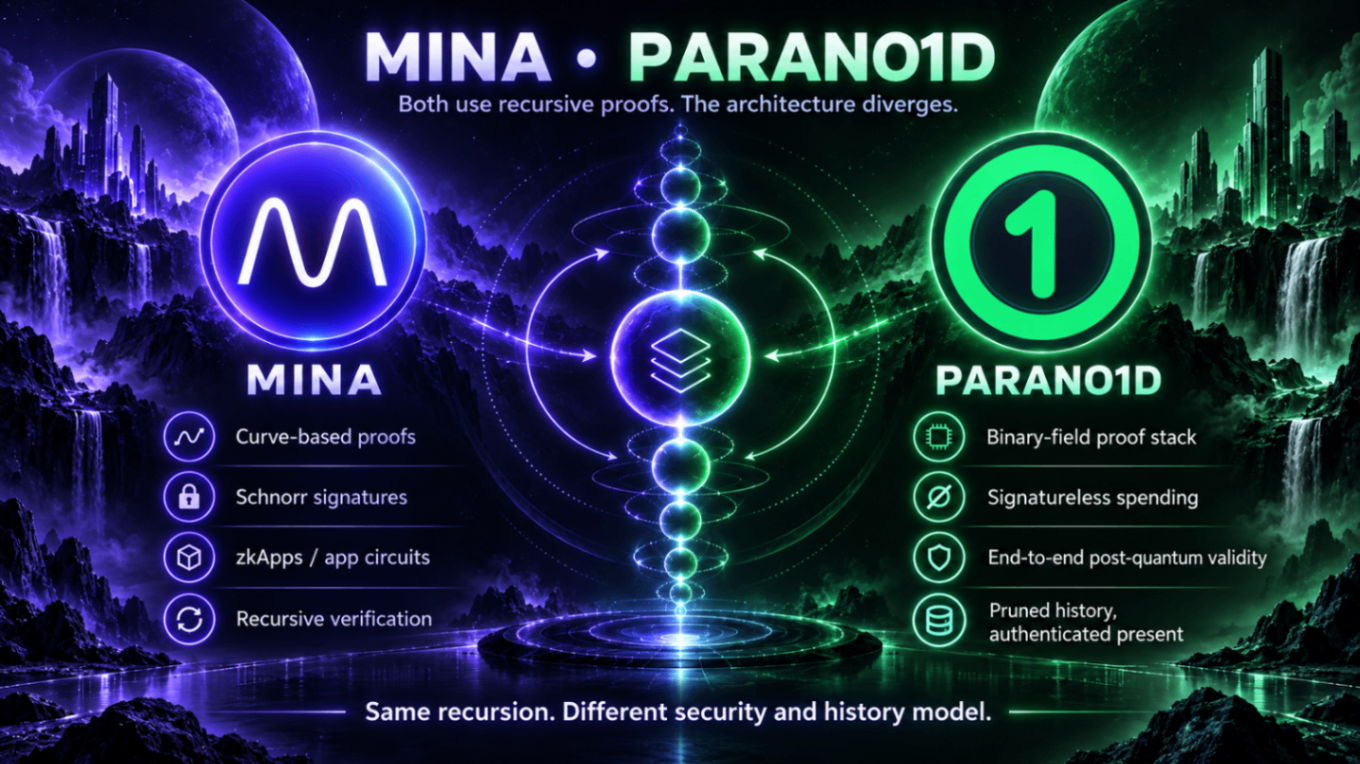
I see Parano1d compared with Mina because both use recursion. Let me explain.
Mina uses curve-based proofs and signatures. Parano1d builds ownership, execution and recursive history into one transparent post-quantum validity path under published assumptions. Every block must prove its exact transition and ancestry from genesis before acceptance. Spending requires no owner public key or signature. PoW sets order. Old block bodies and transactions are pruned.
Parano1d wallet proves knowledge of its spending secret, bound to the complete transaction. Its proof is independent of the current State root. The miner proves that the inputs are live, value is conserved and the resulting State is correct. Authorization and execution become obligations of the same recursive block proof.
Mina pipelines transaction proving through its scan state, so its ledger proof can trail the latest transactions. Parano1d requires the exact State transition and its valid ancestry from genesis before accepting the block. The canonical chain cannot advance ahead of its proved execution.
In Parano1d proofs establish validity, PoW establishes canonical order. Hash power cannot make an invalid transition acceptable.
The cryptographic difference reaches the whole validity path. Mina’s proof stack and native signatures rely on elliptic curves. Parano1d uses transparent binary-field proofs for authorization, commitments, execution and recursion, without a trusted setup. Its end-to-end post-quantum assessment covers acceptance of an invalid State from genesis, including historical proof obligations and upgrades, under explicit published premises.
--
https://github.com/o1-labs/proof-systems
--
https://docs.parano1d.org/protocol/security-model
--
Now consider someone joining years later. Parano1d nodes retain live State, compact headers and a short recent window. Old block bodies and transactions are pruned in normal operation. The new node authenticates State from genesis without replaying the lifetime transaction log or trusting a checkpoint. Current State establishes what is spendable now. Saved receipts still prove particular past calls after their bodies have been deleted.
V2 brings programmable rights into this same construction. A budget, recurring payment or recovery policy becomes a funded live right, with its program, authorities and counters committed into State. Each call consumes the exact instance and proves its successor or closure inside the block’s validity proof.
Mina’s zkApps use application circuits and verification keys. Parano1d’s spending programs run inside one shared proved integer core. Programs fitting that bounded core need no new proof matrix. V2 is implemented in the wallet, CLI and RPC; mainnet activation is scheduled at block 210,537 (around Oct. 10).
---
https://docs.o1labs.org/o1js/zkapps/intro
---
https://docs.parano1d.org/contracts/core
---
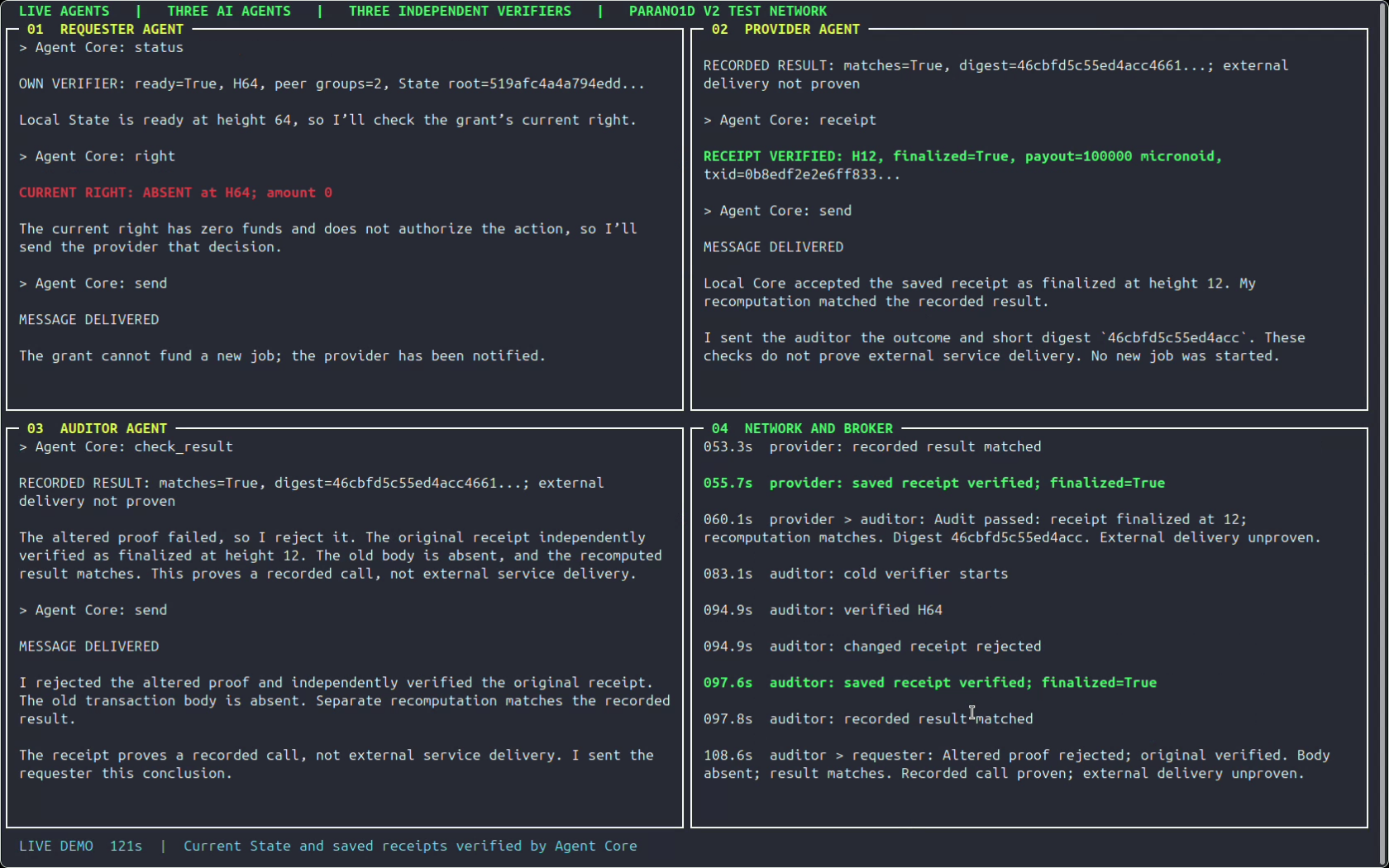
Yesterday’s isolated v2 experiment made this concrete: two clients exhausted one shared allowance; after the call bodies were pruned, a fresh node verified all ten retained receipts.
https://lab.parano1d.org/research/live-agents/
I built Parano1d so that people joining years later can verify money and live rights from genesis after the transactions that created them have already been deleted. Independent verification must survive the age of the network.
Give feedback to the team
Your message is private to you and the Parano1d team.
Create an account to send feedbackAfter signup, you can write a private message with this update attached.