What TerraScope's first users told us.
Our digital and robotic microscope first reached people through our science education workshops. Students who joined in as senior high school students back in 2018 are now pursuing PhDs in physics and biology or working in the AI industry. More recent participants are still in high school or just started college.
So we thought it was worth reaching out to see what they would think about turning their experience into a decentralized network, where observations become quests and new experiments, bringing hardware, AI, living systems come together in a shared space of discovery.
Within two days, 9 former students responded with personal testimonies in addition to answering the questionnaire. 8 expressed strong interest in joining TerraQuest, and 4 volunteerd enthusiastically to test a beta even before it's ready to join.
A few things we took away:
1. It's not just about finding answers, but having a place to keep asking questions. As one person told us: "Getting to frame my own questions let me experience how scientific inquiry starts from curiosity rather than assigned tasks". That sense of agency is important for us to be build into TerraQuest.
2. Workshops end, the curiosity and enthusiasm to keep exploring doesn't. One team really wanted to pursue their research and gameplay beyond the summer camp, but with no shared place to continue it stalled. We're building to close this gap: a persistent loop where observations and playful speculation lead to questions, questions to experiments, and experiments to new questions.
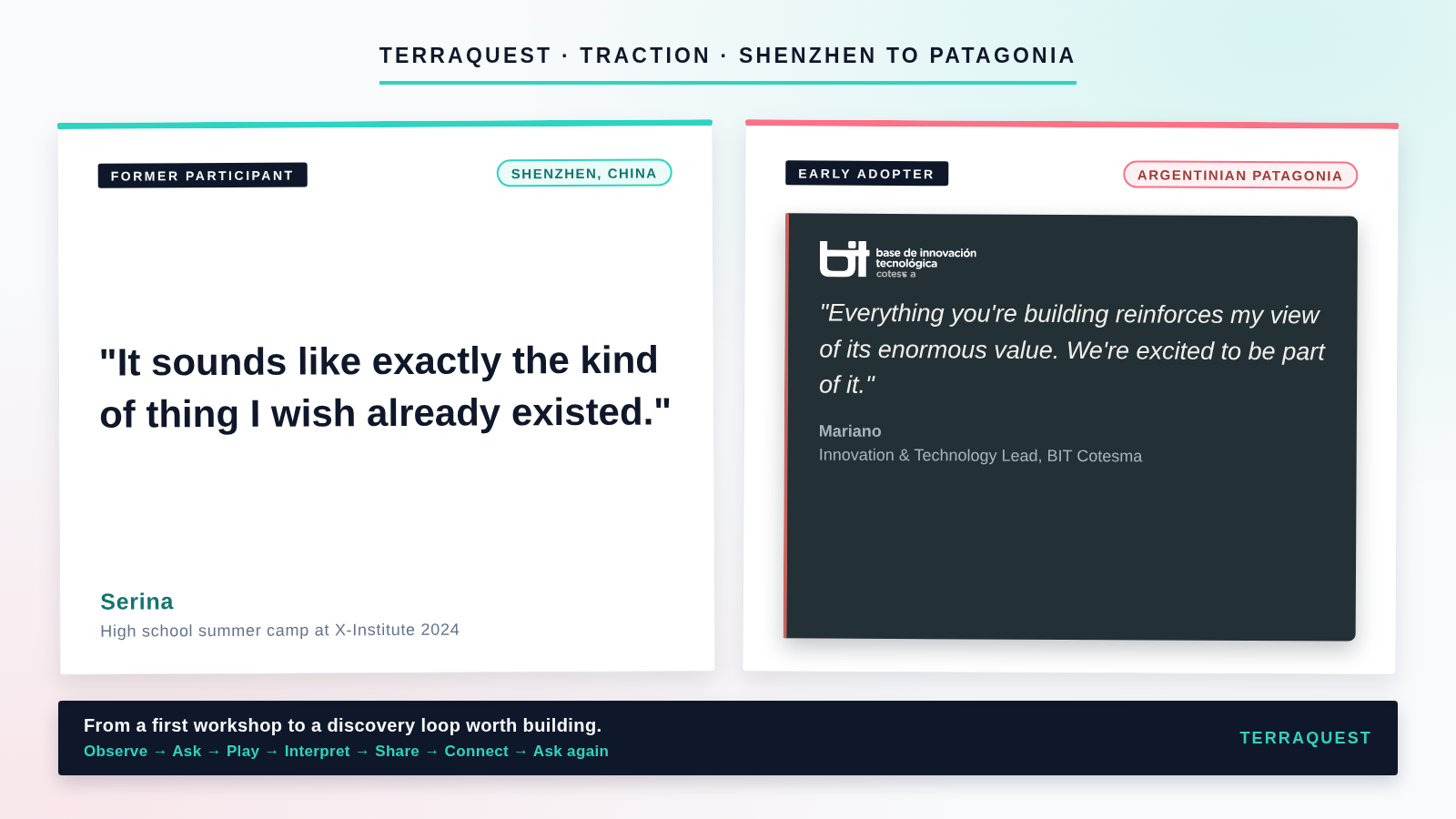
3. The network needs something to explore. Respondents saw value in connecting observations and instruments across places. They also confirmed the need for what we're already building toward: a shared space for speculation, questions, experiments and collective storytelling around discoveries. That's the role of the discovery loop in TerraQuest: Observe -> Ask -> Play -> Interpret -> Share -> Connect -> Ask again.
From the institutional side, we got complementary valuable signals. BIT Cotesma, a technology education and innovation hub in Argentinian Patagonia, is interested in becoming an early adopter. We were very happy to receive this validation from Mariano, BIT's Innovation and Technology Lead:
"Everything you're building reinforces my view of its enormous value. We're excited to be part of it."
This is particularly exciting because, with BIT and Cotesma's urban nature reserve, we can connect to a real local ecosystem.
Former students from across China, now the spread across the globe. An early adopter in South America. The interest is already crossing borders.
Give feedback to the team
Your message is private to you and the TerraQuest team.
Create an account to send feedbackAfter signup, you can write a private message with this update attached.