
SolTrace Update: From Prototype to Reproducible Research Infrastructure
Since the previous update, SolTrace has evolved from a working trading prototype into an integrated research, replay and verification platform for Solana market decisions.
The latest development connects the Predictive Aiming Lab, strategy replay, policy translation and the Decision Ledger into one optional verification workflow. The objective is to measure where predictive features help, fail or make no material difference, while preserving the decision context behind every result.
Predictive Aiming Lab
The Predictive Aiming Lab analyses market observations, coin trajectories and freshly calculated forecast features. It creates a frozen calibration for the subsequent comparison. Training, validation and holdout portions remain separate.
For a selected policy, SolTrace can compare two branches: predictive features enabled and predictive inputs neutralized. Both branches use the same policy, recorded observations, capital, modeled costs and execution-delay assumptions. Forecast values are recalculated from observations available at each decision point. This makes it possible to examine the effect of prediction on entries, exits, trade frequency, drawdown, execution and returns under consistent conditions.
Strategy Replay and Decision Ledger
The selected strategy is replayed chronologically. Rule values, thresholds and decision reasons are linked to simulated outcomes such as fills, rejections, cancellations and open positions.
The Decision Ledger records the decision context and generates evidence with frozen inputs, model information and SHA-256 checksums. Results can be marked inconclusive when calibration support is insufficient, execution is incomplete or positions remain open.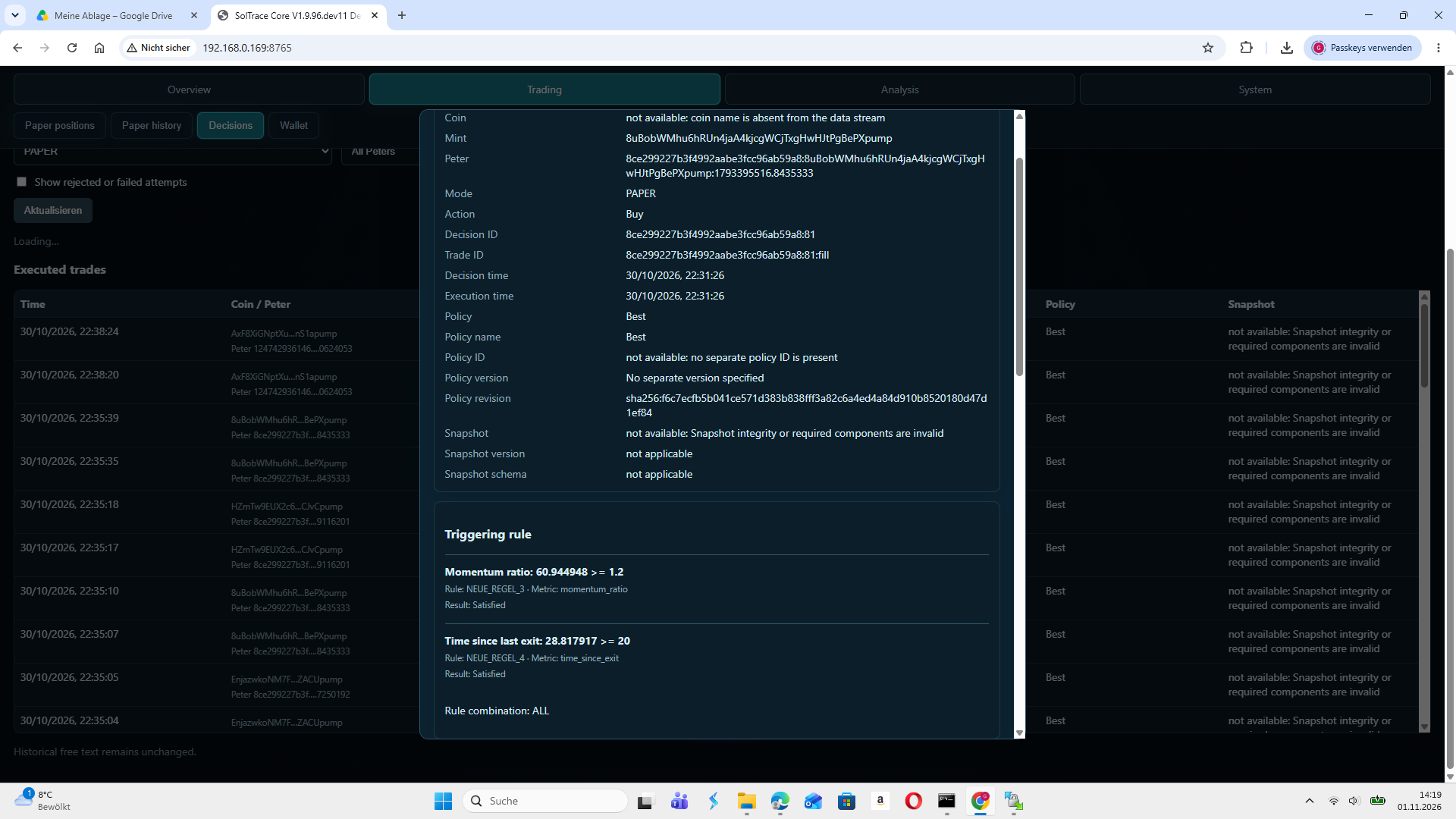
Analysis-to-Policy Translation
Analysis results can be translated into an editable policy draft. Observed relationships between individual features and feature pairs become explicit rules with thresholds and policy families.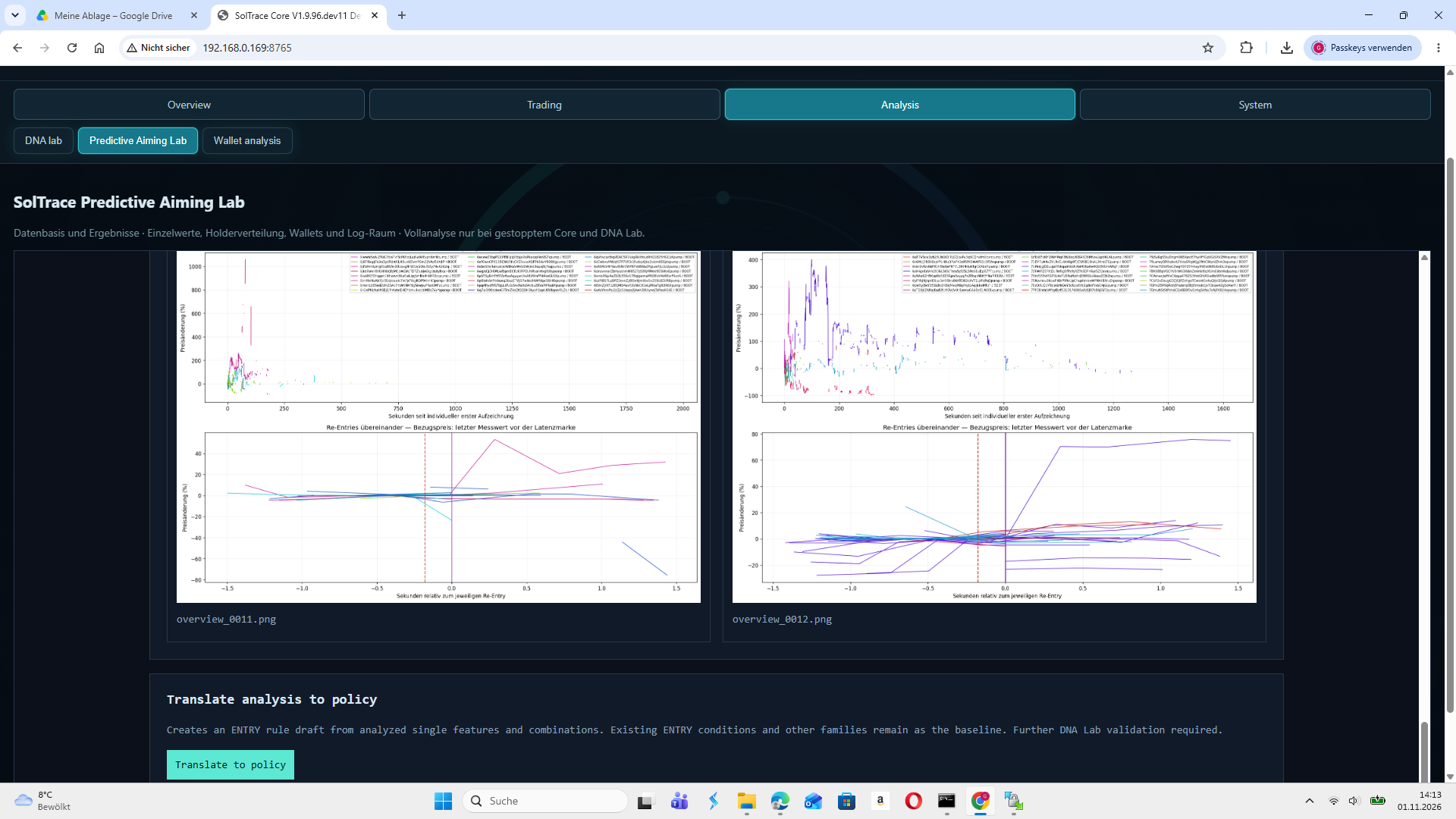
The editor supports ENTRY, HOLD, EXIT, REENTRY and DROP. Rules can be combined with nested AND/OR groups and explicit parentheses. The generated policy remains editable, reviewable and separately publishable. Translation does not automatically activate a trading strategy.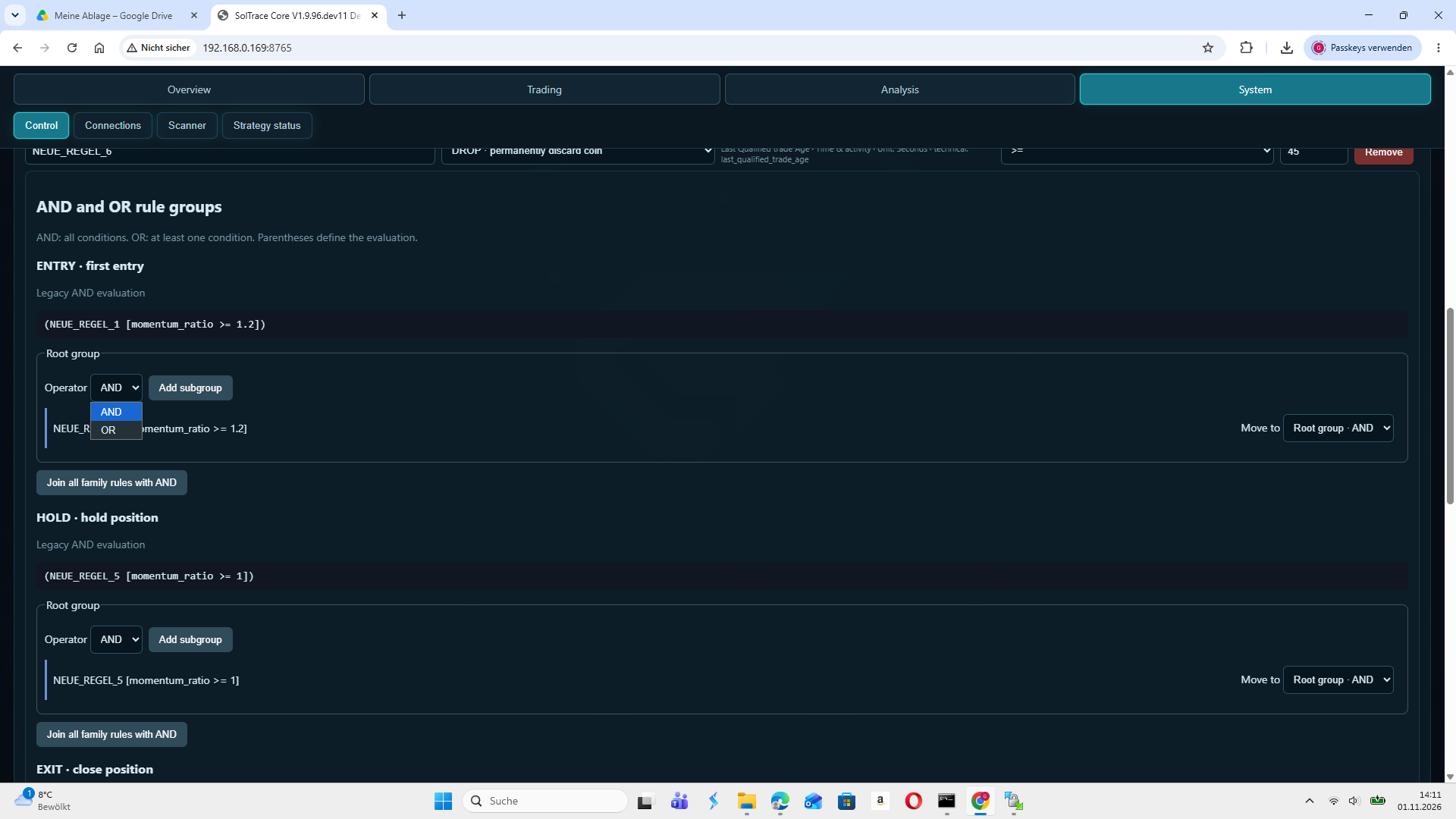
Current Data Foundation
A complete inventory of the SolTrace installation reports:
• 182,637 stored files
• approximately 369.5 GB of project data
• 705 database files
• 69,662 JSON artifacts
• 167 analytical segments
• 148 identifiable recording runs
• 176,587 unique Solana addresses detected across stored records
• no unreadable files in the inventory scan
The address inventory is classified where identifiable into coin/mint addresses, wallet addresses, holder addresses, creator/deployer addresses and other Solana accounts. The total is therefore an address inventory, not a claim about the number of unique coins.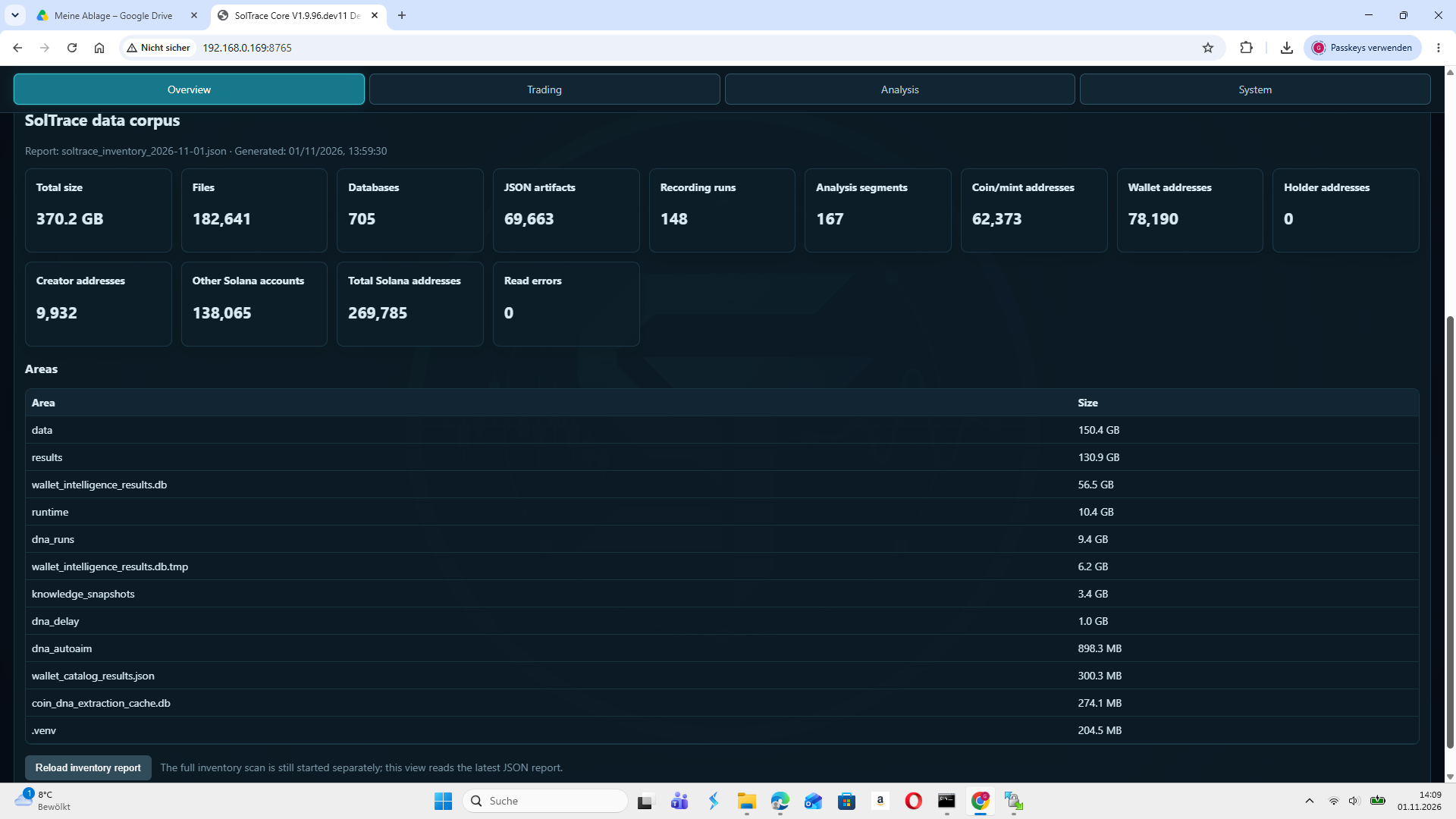
The corpus includes historical recordings, Peter trajectories, wallet intelligence, predictive-aiming results, replay data, policy artifacts and research evidence. The largest databases contain tens of gigabytes.
SolTrace now has a public website: https://soltrace.pages.dev/
Explore the platform in English or German—from its accumulated data foundation and research tools to paper trading with latency and fee simulation, configurable policies, and the Decision Ledger.
SolTrace is operated and validated on a private server. The next step is to validate the integrated workflow with real recordings and newly collected data, then document which results are reproducible, inconclusive or directly explainable from stored evidence.
Give feedback to the team
Your message is private to you and the SolTrace team.
Create an account to send feedbackAfter signup, you can write a private message with this update attached.