Second Name lets you prove you meet a requirement without handing over who you are. The idea is more than forty years old.
The history
1981-1985: David Chaum introduced digital pseudonyms (1981), blind signatures (1982), where a bank signs money it can't trace, and in "Security Without Identification" (1985), credentials shown under different pseudonyms without being linked. Prove only the fact that matters. That is the core of Second Name.
December 1987: Tim May met economist Phil Salin, who raised an objection May couldn't answer: sellers couldn't get paid anonymously. May reread Chaum and saw it was possible. Our desk game, The Unanswered Objection, is set that month.
1992-1993: May, Eric Hughes and John Gilmore started the Cypherpunks list. Hughes wrote: "Privacy is the power to selectively reveal oneself to the world."
1993-1996: anon.penet.fi gave people anonymous email addresses until a court ordered a user revealed. The operator held the table linking nyms to real names. Second Name is built so the partner never gets that link.
1997: Adam Back posted Hashcash, proof of work that's costly to make and instant to check, each stamp spendable once. Bitcoin later cited it.
What Second Name is
A second name is a nym. An app checks one narrow fact and issues you a private credential. Another app asks for the claims it needs. You approve or decline, and it gets a yes or no and which claims were met. Nothing else. No KYC, no exposed wallet history. It doesn't prove anyone is human or unique.
The name you earn, and the proof you choose to share.
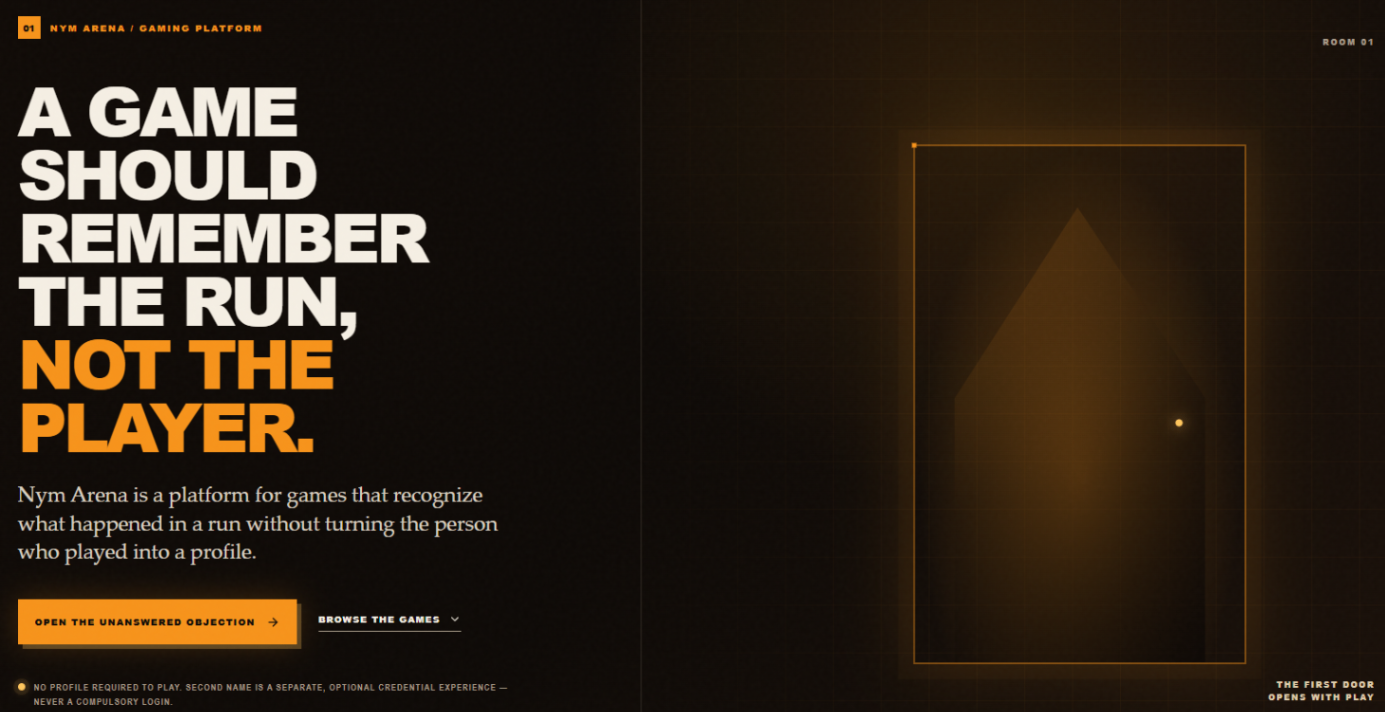
Nym Arena
The Unanswered Objection: a four-act 1987 desk game where you build private digital cash with envelopes, carbon paper and wax seals.
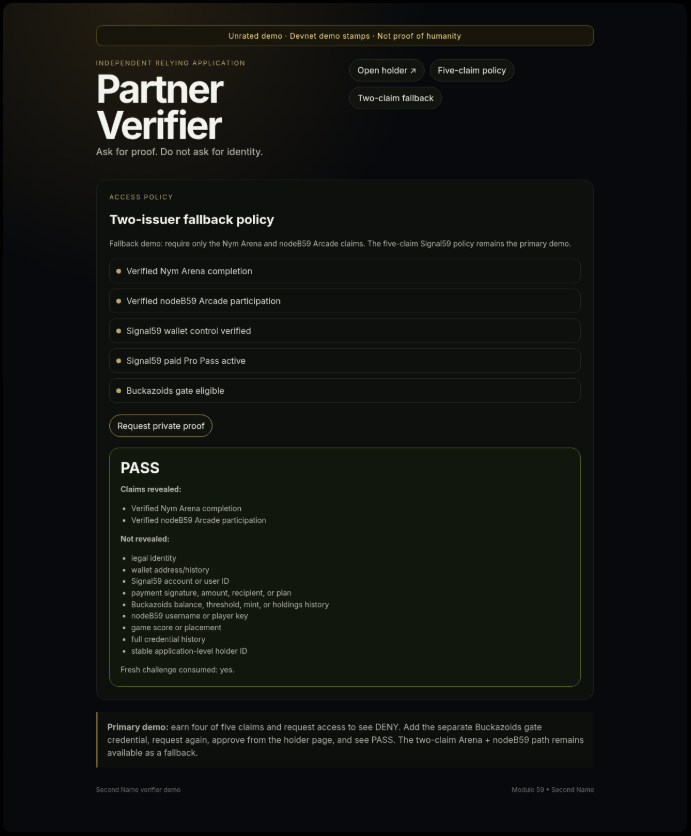
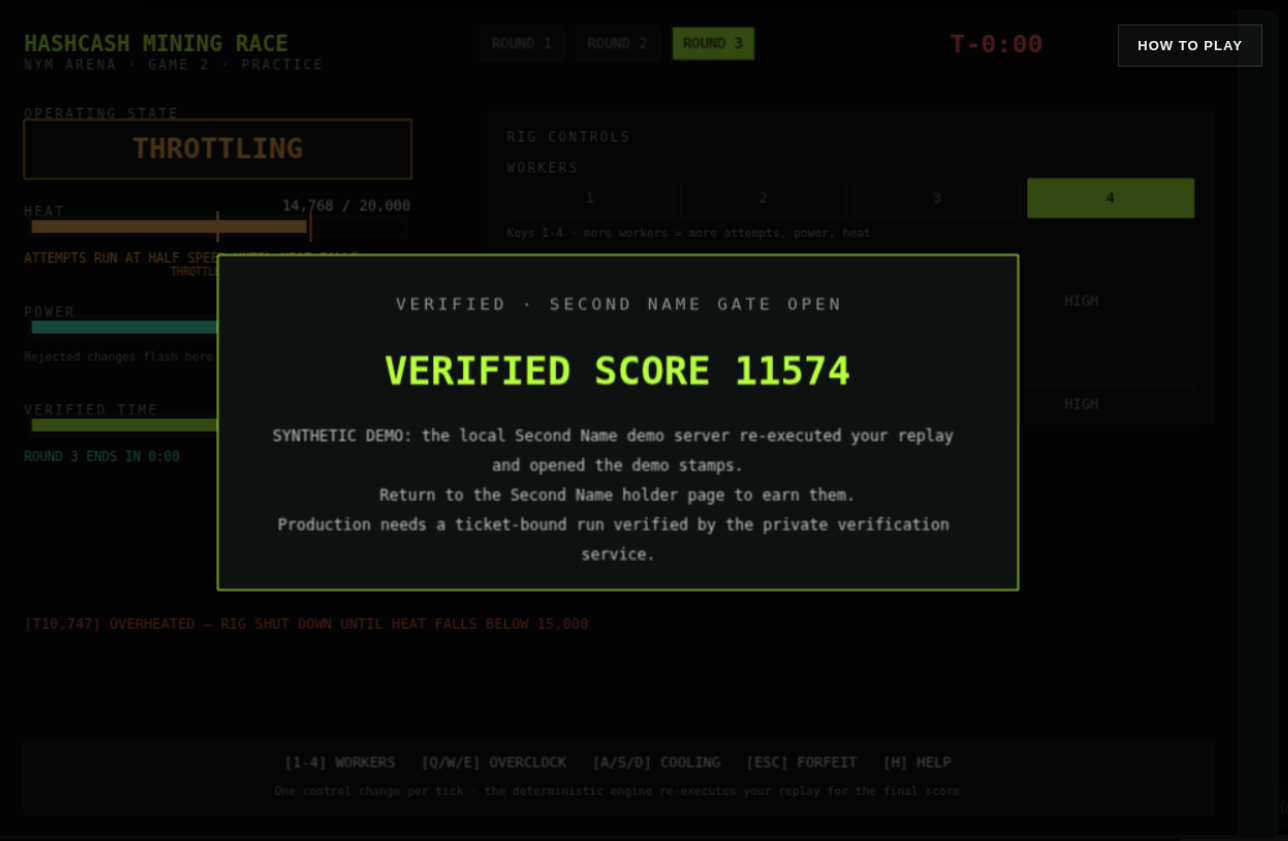
Hashcash is the gate: a three-minute rig game. The browser never grades itself; the server re-executes the replay. Seeds are server-issued, single-session and one-time, so a resent replay is refused like a spent stamp. In the demo the server checks runs, labeled SYNTHETIC DEMO. In production, the private verification service does five claims, consent first.
1. Nym Arena completion
2. nodeB59 Arcade participation
3. Signal59 holder verified
4. Signal59 Pro Pass
5. Buckazoids holder eligible
The last three are for SIGNAL59, a low-cost info tool for the Buckazoids community with holder-gated tools. In the demo they come from test data, and public mode doesn't issue them.
Illustrative, simplified partner result:
{
  "allowed": true,
  "revealedClaims": ["Nym Arena completion", "nodeB59 Arcade participation", "..."],
  "notRevealed": ["legal identity", "wallet address/history",
                  "game score or placement", "full credential history",
                  "stable application-level holder ID"],
  "challengeConsumed": true
}
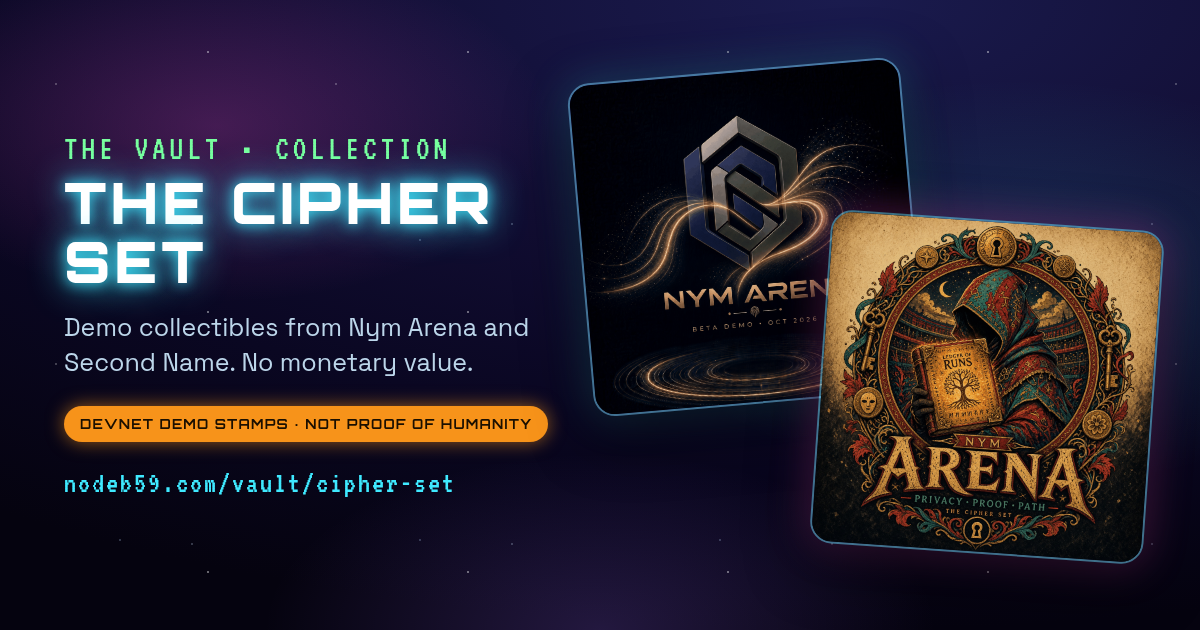
The Cipher Set
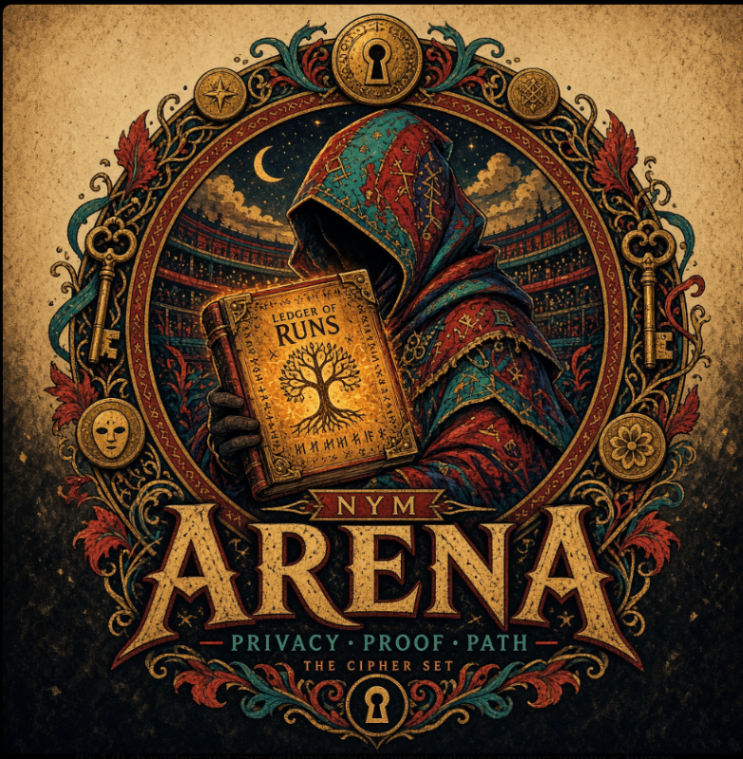
Two collectibles, designed and minted on Solana Devnet: Beta Participation, for joining the beta, and Verified Achievement, "Ledger of Runs", for a verified run.
The player claim flow is built:
Pass the gate and you get a one-time claim code that expires after 12 hours. The server stores only a hash of it.
At the demo, you enter the code and a fresh Devnet wallet on a local approval desk. The code is burned on use.
The issuer reviews each mint one at a time and signs it in their own wallet. No keys are held on the server.
A mint is recorded only after it's confirmed on-chain.
One Beta per wallet, one Achievement per verified run. Agent play never gets a collectible.
Where it stands
This is a Devnet demo in progress, not a live product. 141 of 141 tests pass on the local build, and a full browser playthrough of the five-claim flow passed. The demo currently runs on test stand-in validators, clearly labeled. Next: the real validators, the first player mints and a public demo on nodeB59.
The demo is labeled: Unrated demo · Devnet demo stamps · Not proof of humanity.
Follow along at nodeB59 on X https://x.com/nodeB59
Give feedback to the team
Your message is private to you and the Second Name team.
Create an account to send feedbackAfter signup, you can write a private message with this update attached.